Often times, images along stories play the role of helping readers visualize a distant reality or part of the world. They help to express a mood, give a sense of place or to illustrate a scene. In formal storytelling settings, like news stories, for example, that illustrative role is generally reserved to photographs. Photojournalism has the ability of serving as documentation and is generally accepted as a more precise representation of reality. (Or, at least, generally accepted as a fair representation of a split second of reality.)
Illustrations, on the other hand, when used in journalism, generally serve the role of inviting readers to stop and read the stories. Often times, they are simply used as decoration. Except for illustrations in information graphics and diagrams — which generally look and feel like more technical drawings —, drawings are rarely used as descriptive storytelling tools in journalism.
But is there a moment in more objective, formal and literal storytelling, like journalism, when illustrations can fill in a more descriptive role? Would it be possible that illustrations could work as well or, in some ways, better than photographs, without looking like technical drawings?
To try to answer these questions, I will consider the examples of a photographs of Lima (2018) and the illustrations of Weiben (2015) representing the refugee crisis in the Greek Island of Lesbos.
In the two photographs below, Lima shows a makeshift refugee camp (figure 1) and vests that refugees abandoned near the beach (figure 2), after leaving the boats that brought them to the Lesbos.
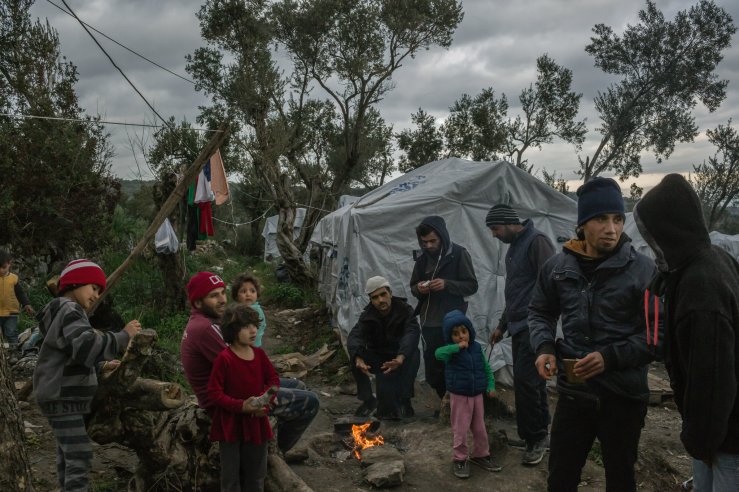
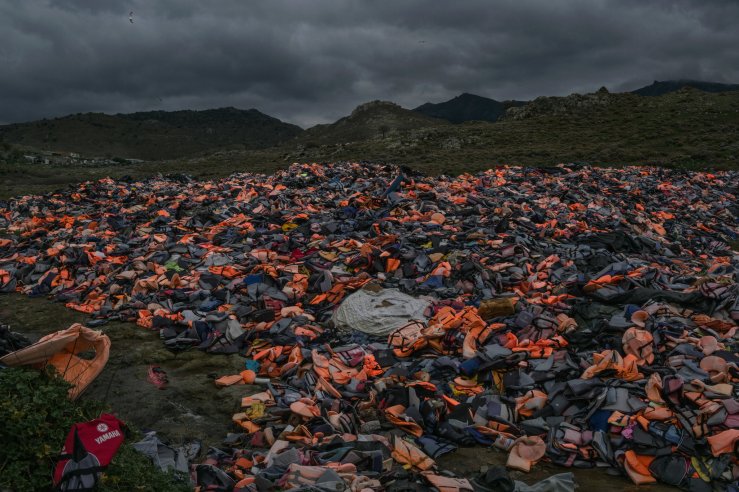
Illustrator Peter Wieben set out to try to tell the refugee story with illustrations. Figures 3 and 4 show similar scenes to those seen on Lima’s photographs.
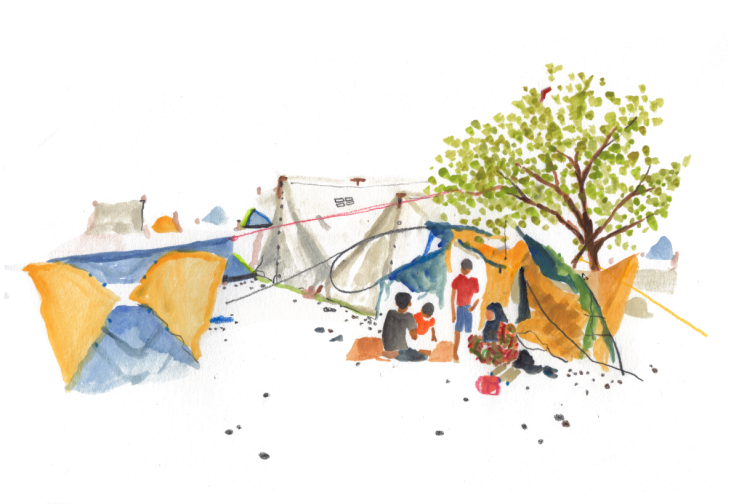
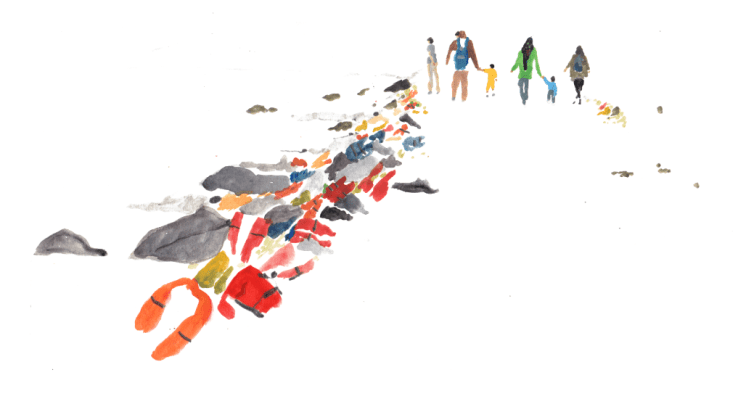
Wieben’s drawings were part of a series of sketches that he made while visiting Lesbos. He published the drawings on his website along a story that described the scenes, at the peak of the refugee crisis.
Lima’s photos are obviously a more literal representation of a millisecond of real life. But the photographer makes decisions on exposure time and shutter speed that control how light will be recorded. Lima’s use of light creates a moodiness that is often different of what can be seen by the human eye in the same location. To some extent, the photograph is not the actual representation of that moment, but Lima’s manipulation of it.
Wieben, on the other hand, abandons every attempt of capturing details of the scenes that he represents. His drawings capture the moments very differently from Lima’s photos. They give an idea of dimensions, colors and placement of objects. As a result, his final product is a not a manipulation of the moment, but an attempt to capture a mood and the artist’s perception of that moment.
My conclusion after observing Wieben’s work is that yes, illustration can, sometimes, work as well or maybe better than photographs to capture scenes when the mood is more important than details.
As a example, let’s consider the scene represented in figure 5, below. Wieben’s (2015) story described: ‘There are people sleeping everywhere … they are living rough on the streets, by the thousands. Men, women and children, sleeping in desperate circumstances, many with only cardboard to serve as bedding. There is no water, no bathrooms. No food.’
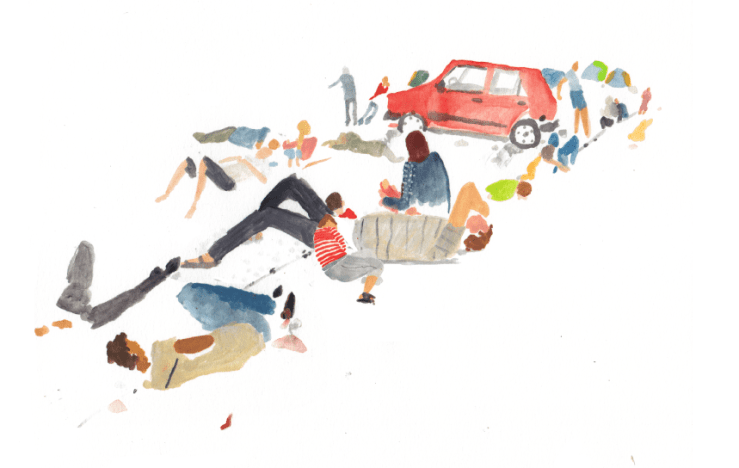
Weiben’s drawing proves that often it is not necessary to show hyperrealistic details to capture a scene. Sometimes, even part of a body is enough to transmit the impression of a human figure.
Illustrations are especially good way to capture intimate scenes, especially with children, who may be hard to photograph. Also, to communicate moments that otherwise might be excessively gruesome or hard to access with a camera. Figure 6, below, is an example of that. This is how Wieben (2015) describes the scene: ‘A girl of sixteen calls to her mother. Her little brother, seven, vomits after setting foot on Lesvos. As he stands his legs are shaking.’
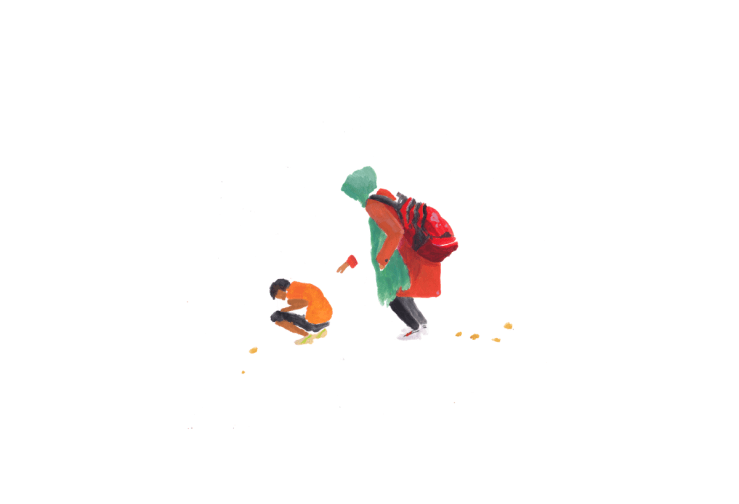
Figure 6 allows readers to focus on the drama of a sister trying to help her little brother, who is feeling sick after finishing his journey. There is no need for visual details of his illness and the precise identity of the boy doesn’t really matter in the context of this crisis. This is one moment, one drama.
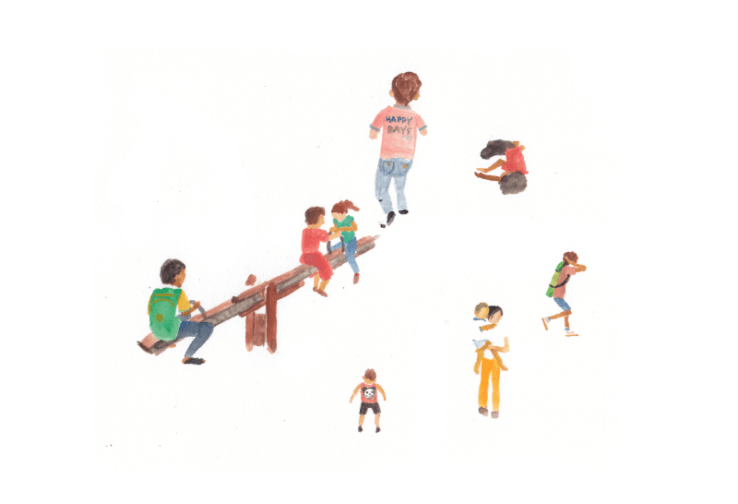
Drawings can transmit a mood that could be hard to capture in a photograph. On figure 7, below, Wieben sketched children playing near a makeshift refugee camp. ‘There are many children,’ Wieben (2018) wrote. ‘The children wander, sometimes finding playground equipment, sometimes inventing their own games.’
*
References:
LIMA, M. (2018) ‘Greece’s Island of Despair.’ The New York Times. [Online] March 29, 2018. Available from: https://www.nytimes.com/2018/03/29/world/europe/greece-lesbos-migrant-crisis-moria.html [Accessed on Nov. 17, 2018]
WIEBEL, P. (2015) ‘Children’s Island.’ Peterwieben.com. [Online] September, 2015. Available from: http://www.peterwieben.com/stories/#/lesvos/ [Accessed on Nov. 17, 2018]





 Sergio’s research & enquiry