The American cartoonist Jeff MacNelly used to say that the best thing for his creative process is a deadline (Adelman, 1991). A fixed due date is definitely an accelerator for any creativity, including mine. Working in a newspaper, as I do, demands a compromise with time. The time pressure could add another layer of the agony that I feel between the assignment and the final product.
In the past three months, I have been doing more illustrations, at work and for myself, in an attempt of exploring and documenting what I see in the world. As inspiration can be triggered anywhere, I have been more conscious of my surroundings and of others, and have been carrying a sketchbook with me.
After analyzing the work of so many illustrators, I decided to take some time to reflect about my own creative process. I will divide this reflection in the next two posts. The first (this one), will talk about works that I did for myself. In the second post I will talk about the work for my job.
A key difference is that when I work for myself there are no set deadlines. It is just a flaneur, a stroller in New York city, experiencing and observing the city where I live. As for work, the world is vastly different, with deadlines and editors on my neck — I will discuss that in my next post.
On my personal projects, my creative development starts with observation/perception of the behavior of certain groups and their daily lives; of landscapes that call my attention; of how people interact. I am a sort of sociologist documenting people and their behavior with sketches.
Adler (1928) has contributed to my comprehension of myself and my work, specially during my observation phase.
‘The psychic life of man is determined by his goal. No human being can think, feel, will, dream, without all these activities being determined, continued, modified and directed, toward an ever-present objective. This results, of itself, from the necessity of the organism to adapt itself and respond to the environment.’, (Adler 1928, p.20).
Observation is seminal to my drawings. Figures 1and 2, below, illustrate my observation phase. I took these photographs while observing how New Yorkers walk, for a short visual story that I am calling ‘Walking like a New Yorker’. The story will illustrate some skills that every New Yorker knows, and that help to make more manageable in the overcrowded city.


As the Spanish painter Pablo Picasso said, ‘to know what you’re going to draw, you have to begin drawing’ (Harrison, 2014). So, the second step in my creative process is to actually draw. Figure 3, below, shows a few samples of my sketches for ‘Walking Like a New Yorker’.
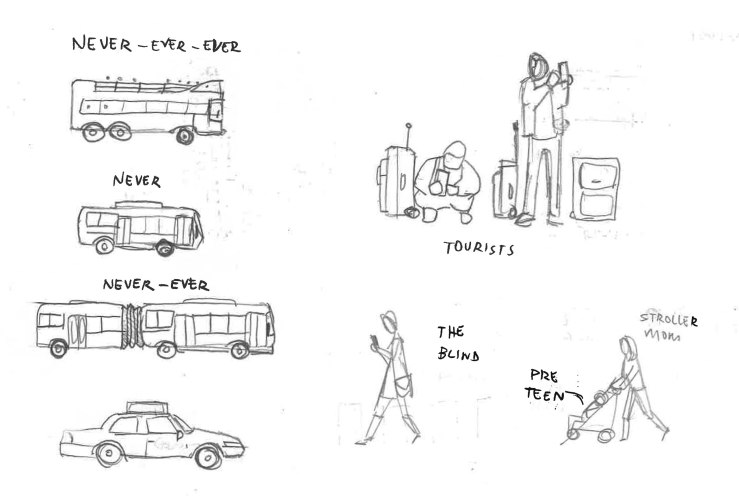
The third part of my creative process is getting some critical feedback from someone I trust. On personal projects, normally the victim is my wife. By doing that, I pay attention to her expression and reactions. If I see a smile, I know that I am probably going in the right direction. When I noticed that she doesn’t understand, I might make adjustments.
The next part is finishing the drawings. The duration of this fraction, depends basically on the deadline that I have. And the fifth part is publishing.
After this closer revision of my creative process, I came to the conclusion that:
- When I am working on personal projects, I tend to stop in the third part of it (sharing/showing). The project used as an example for this post is paused on the sketch step;
- Personal projects tend to happen considerably slower than professional ones;
- Without a deadline, I am likely to procrastinate;
- With this in mind, I noticed that a deadline is a fundamental difference between my personal projects and those that I do for my job; I come full circle to MacNelly’s observation. Without a deadline, the sketches could lose themselves.
- Even when working in personal projects that are not initially planned for publication, there is a need of a deadline as a strategy to accomplish my goals.
*
References:
ADELMAN, K. (1991) ‘Quick Draw.’ The Washingtonian. [Online] May 1991. Available at: https://www.washingtonian.com/2015/06/12/jeff-macnelly-interview/ [Accessed on Dec. 5, 2018.]
ADLER, A. (1928) Understanding Human Nature. London:Inprint (Reprint of first edition by Martino Fine Books.)
HARRISON, S. (2014) Aiga Eye on Desigin. [Online] Dec. 31st, 2014. Available at: https://eyeondesign.aiga.org/pablo-picasso-design-quote-you-have-to-begin-drawing/ [Accessed Nov. 15, 2018.]
PEÇANHA, S. (2018) Sketches and reference photographs for Walking Like a New Yorker. Unpublished.

 Sergio’s research & enquiry