***
Is the Way That Adults Read Picture Books Changing?
My main interest in this research is to get a better grasp on how to create engaging visual storytelling for adults. As part of this inquiry, I looked into the works of several authors of adult picture books. But I also read text about other subjects, like picture books for children, for example, and a few academic papers about how words and images presented side by side can alter the understanding of the ‘visual text’ and of the ‘verbal text’ (Sipe, 1998, p. 107).
But I was especially interested by Nikolajeva & Scott’s (2001) comments about the differences between how adults and children read picture books. They explained that readers looks at pictures, read words and create a cohesive meaning through that back and forth between images and verbal text. According to the authors, the construction of a message by consulting both image and words comes naturally to children. But it didn’t seem to work the same way for adults:
‘Too often adults have lost the ability to read picture books in this way, because they ignore the whole and regard the illustrations as merely decorative. This most probably has to do with the dominant position of verbal, especially written, communication in our society, although this is on the wane in generations raised on television and now computers.’ (Nikolajeva & Scott, 2001, p. 2)
As I considered Nikolajeva & Scott (ibid.), I realized that as children become adults, the use of illustration becomes largely limited to what is available in newspapers and magazines. In most adult publications, illustrations are often used to represent a general idea; their goal is mostly to get readers to stop and read the words, and not to carry a whole lot of meaning on the illustration themselves. This recurrent function reinforces the gap observed by Nikolajeva & Scott (ibid.), that adults tend to regard illustrations as merely decorative.
The gap is evident even in publications where illustrations play a crucial role. In The New Yorker magazine, for example, illustrations are essential to the publication’s personality. The New Yorker is known for long narratives, for abundant use of cartoons and for having illustrations in every cover. (Figures 1, 2 and 3, below.)


Small illustrations and cartoons are used in pretty much every page, like in the four sample pages reproduced below. (Figures 4 and 5.)


But most of the time, readers are either consuming the words or the pictures. Frequently, there is no meaningful relation between them. The drawings are used as breaks for the long stories, as visual relief for the graphic design and as decoration. But, most of the time, they are not used in the magazine to illustrate, reinforce, explain or clarify the story that sits on the same page.
Figure 6, below, is an example of an illustration that contains a very subjective visual joke that works by itself and that has no relation with the article that surrounds it.

In The New Yorker illustrations are largely stand-alone images. But there are few exceptions when there is correlation between words and images: most notably, in cartoons and in a special section called Sketchbook.
Still, the words in each cartoon are only related to the cartoon itself. They have no relation to the words in the story surrounding the cartoon on the rest of the page, as seen in Figure 7.
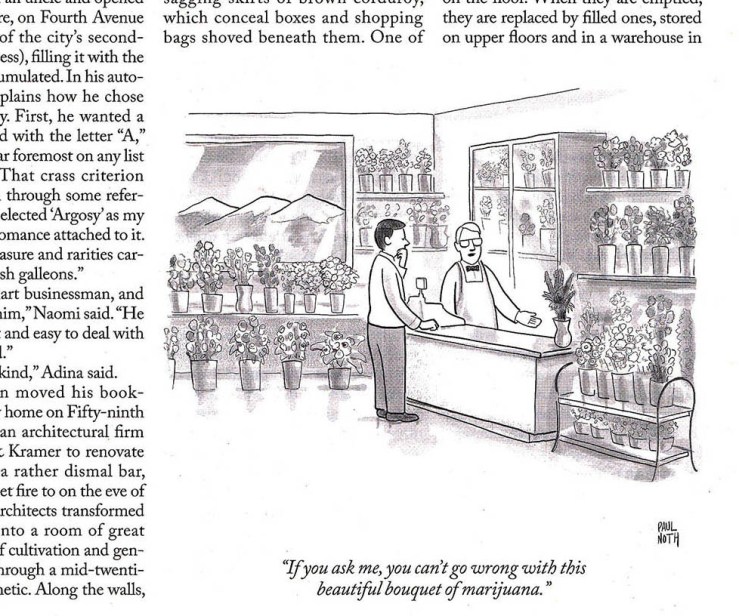
In these examples, it is clear that The New Yorker reinforces the divorce between words and images noticed by Nikolajeva & Scott (ibid.) The most significant exception to that rule is reserved to the Sketchbook section of the magazine, where words and images often intermingle, in a similar way to how they might relate in a picture book for children, as seen in Figure 8.
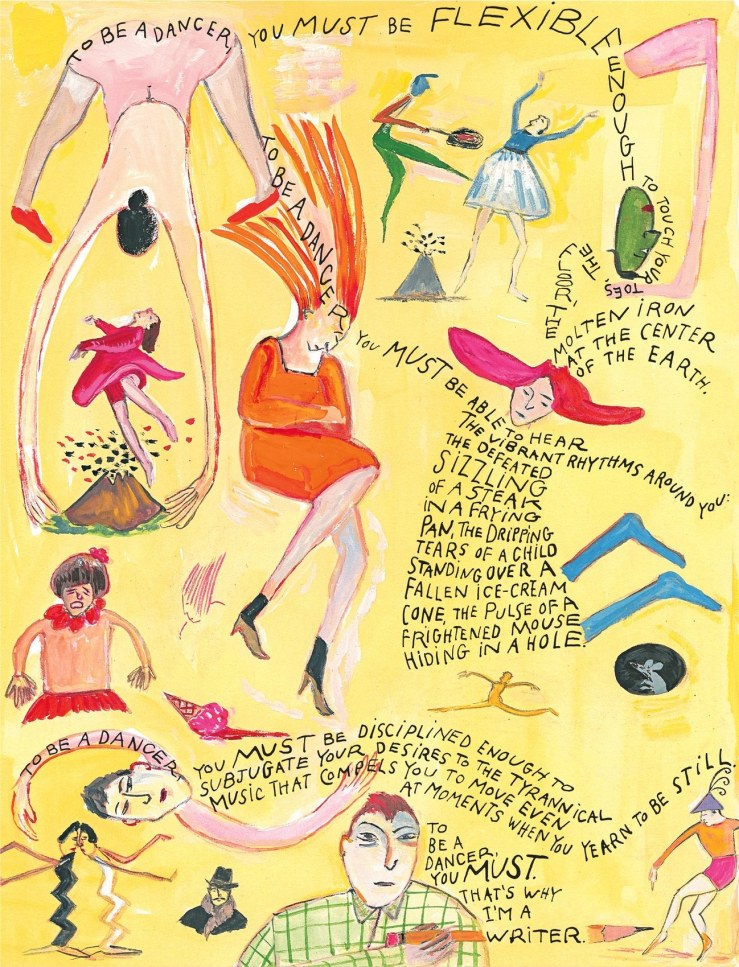
It is ironic that we acquire and become skilled in reading images early in life, but that we progressively lose that ability as we become literate. As I think about how I can develop ways of making words and images relate more seamlessly in adult stories, I need to try to create mechanisms to close the gap that we tend to build as we grow older.
But, as Nikolajeva & Scott (ibid.) noted, this gap is on the wane as new generations raised on television and computers grow up. Their article was originally published in 2001, several years before Facebook, Twitter, Youtube, Instagram and Netflix emerged to redefine the way we consume information and entertainment. Most of the content offered in these digital platforms is visual — photos, videos, animations, memes etc.
In the last decade, we have seen these platforms become a sort of mainstream media, and reshape traditional publishing outlets. One of the key ways that traditional media has been adapting to these changes is by becoming more visual, too, like the digital platforms that they now compete against. In 2017, The New York Times announced that it’s number one priority was to become more visual (Leonhardt et al., 2017).
As a consequence of the digital revolution, the world is currently experiencing a substantial transition is the way that adults perceive the relation between pictures and text. In a way, young adults are maintaining and older adults are recovering that initial instinct of constructing messages combining text and pictures, instead of segregating one from another. It would be fair to say that platforms like Facebook are playing a crucial role in retraining adults on how they perceive the relation between pictures and words.
It seems pertinent to conclude that, as a whole generation is in the fast lane to become more visual, it is likely that the gap between words and pictures has already reduced substantially since Nikolajeva & Scott’s observations from 2001. And it is also likely that the gap will keep getting smaller.
With all this in mind, for me, as a producer of visual content, it seems reasonable to speculate that the market of visual stories and picture books for adults is just about to see a massive explosion in both production and consumption. And this explosion is likely to come in a variety of formats that include picture books, but that has already started and will continue to transcend paper.
*
References:
ANON. (2014) The New Yorker. June 23, 2014. Reproduction of pages 64, 65, 70 and 71 and excerpts of pages 68 and 69. New York: Condé Naste.
ARIZPE, E. and STYLES, M. (2002) ‘¿Cómo se lee una imagen? El desarrollo de la capacidad visual y la lectura mediante libros ilustrad.’ Lectura y Vida, 23(3). Available from: http://eprints.gla.ac.uk/50859/ [Accessed: Oct. 27, 2018]
BLITT, L. (2018) ‘Exposed.’ The New Yorker. March 26, 2018. Cover page.
FAVRE, M. (2018) ‘The butterfly effect.’ The New Yorker. [Online] Feb. 12 & 19, 2018. Cover page. Available from https://www.newyorker.com/culture/cover-story/cover-story-2018-02-12 [Accessed: Nov. 15, 2018]
KALMAN, M. (2016) ‘To be a dancer.’ The New Yorker. [Online] Nov. 21, 2016. Available from https://www.newyorker.com/magazine/2016/11/21/to-be-a-dancer [Accessed: Nov. 15, 2018]
LEONHARDT, D. et al. (2017) ‘Journalism That Stands Apart.’ The New York Times. [Online] Jan. 2017. Available from: https://www.nytimes.com/projects/2020-report/index.html [Accessed on Nov. 15, 2018]
NIKOLAJEVA, M. and SCOTT, C. (2001) ‘How Picturebooks Work.’ Routledge, 2006. Available from: ProQuest Ebook Central, https://ebookcentral.proquest.com/lib/herts/detail.action?docID=1123186. [Accessed: Oct. 27, 2018]
PLUNKERT, D. (2017) ‘Blow hard.’ The New Yorker. Aug. 28, 2017. Cover page.
SIPE, L. R. (1998) ‘How Picture Books Work: A Semiotically Framed Theory of Text-Picture Relationships.’ Children’s Literature in Education. Vol. 29, No. 2 p. 97-108.
 Sergio’s research & enquiry