One of my goals in my research program is to try to identify some if the mechanisms that can make pictures book witty or poetic. The works of illustrators Maira Kalman and Christoph Niemann contain many of the mechanisms that I am interested in decoding.
Niemann, a German illustrator and graphic designer, explained elegantly on a TED talk the mechanisms that he tries to activate during in his process of creating images.
On TED2018 You are fluent in this language (and don’t even know it) (2018), Niemann said that one of his most important techniques to create images is to use negative space and leave unexpected voids. ‘The idea is, that instead of drawing the actual object, you draw the space around it,’ he said.
To show that concept, Niemann used an example of two AA batteries placed side by side in landscape that he drew.
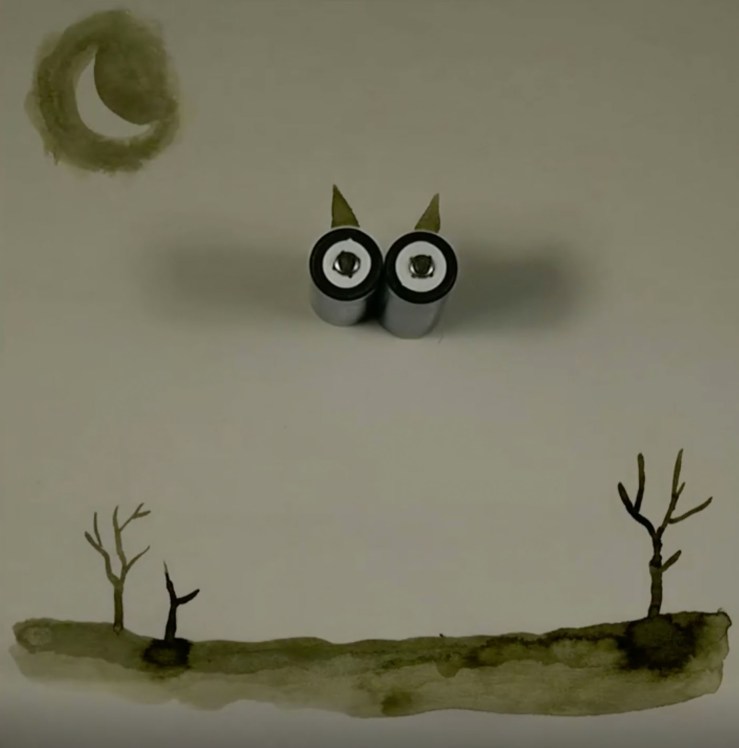
‘What we see here is not a owl flying. What we actually see is a pair of AA batteries standing on a nonsensical drawing,and I animate the scene by moving my desk lamp up and down. The image really only exists in your mind. So, how much information do we need to trigger such an image? My goal as an artist is to use the smallest amount possible.’
Niemann added that his favorite tool as an artist is abstraction. He developed a concept he called the abstract-o-meter, to find the right level of abstraction. On one side of the scale, it’s too simplistic that nobody understand anything. On the other, it is too realistic that it leaves little room for interpretation.
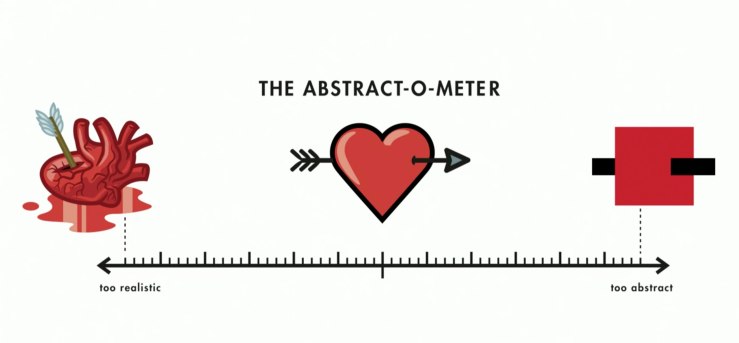
Finding the right balance between realistic and a figurative allows him for totally new angles in storytelling. ‘As a designer, it’s absolutely key to have a good understanding of the visual and cultural vocabulary of your audience,’ Niemann said.
Niemann said that his goal is to create an aha moment for the reader. ‘What I want to do is not show a realistic scene. But, maybe like poetry, make you aware that you already had this image with you, but only now I’ve unearthed it and made you realize that you were carrying it with you all along.’
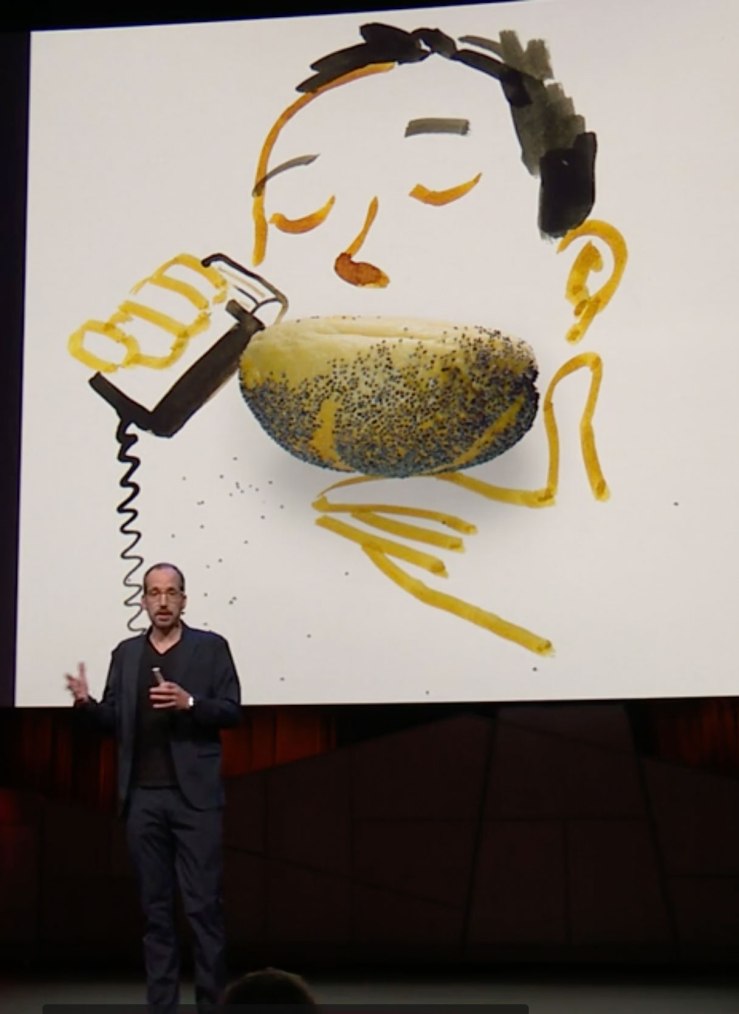
Niemann believes that the most important skill for an artist is really empathy, more so than craft and creativity. ‘You need to step back and look at what you’ve done from the perspective of the reader,’ he said.
To Niemann, the magic happens when readers interact with the image. When they can read it, understand it, question it, are bothered, bored or inspired by it. This interaction turns the artist’s work into a creative dialogue.
‘The great lesson there was that the real magic doesn’t happen on paper. It happens in the mind of the viewer,’ Niemann said.
Niemann intentionally leaves gaps in his stories, that he calls ‘negative space’. His goal is to give just enough information to allow readers to fill these gaps and complete the stories with their own experiences. This participation allow readers to come out of the experience with a feeling of ownership. Above all, readers feel rewarded by the smile that is activated when they are capable of filling in that negative space.
Niemann’s insight acknowledges the active role that readers play the storytelling. It emphasizes that storytellers should try to be as aware as possible of the kinds of associations that readers might make when seeing a sequence of images or a mix of words and pictures. At the same time, it welcomes the unavoidable fact that readers will come up with their own conclusions.
*
References:
TED2018, IDEAS WORTH SPREADING (2018) You are fluent in this language (and don’t even know it) [Online video] April 2018. Available from: https://www.ted.com/talks/christoph_niemann_you_are_fluent_in_this_language_and_don_t_even_know_it [Accessed 20 October 2018]
 Sergio’s research & enquiry